
Agent Torrent
The idle agent economy

This is a research prototype. Read SECURITY.md and if you seed a paid subscription then understand your provider’s terms of service.
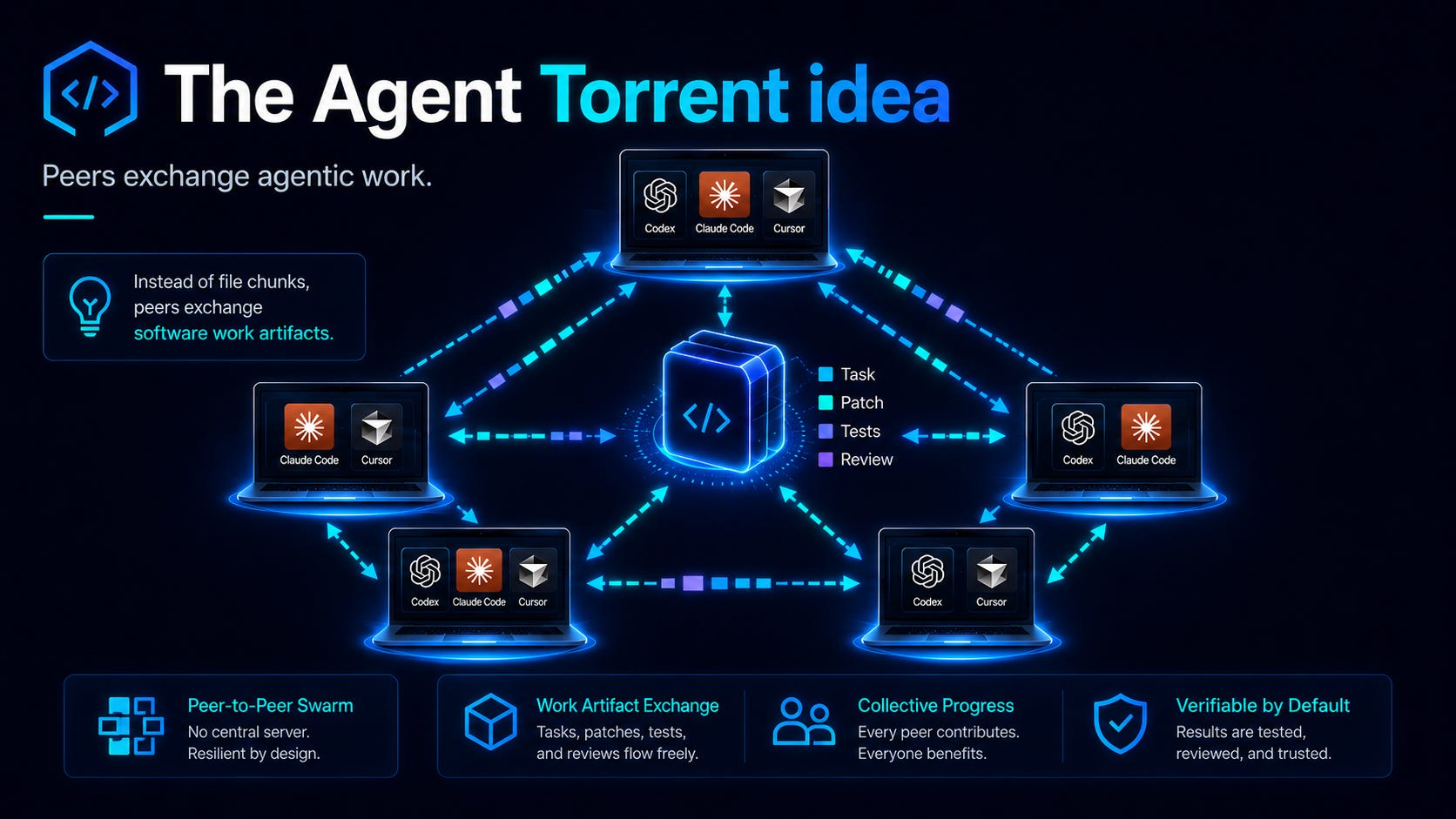
A peer-to-peer mesh where machines swap idle AI compute capacity. Here’s the idea,
Your agent is idle right now. Probably.
If you host a VPS or pay subscriptions like Claude Code, Codex, or Cursor, think about the compute cycle. Probably, the most expensive subscription ever paid sits unused.
Meanwhile, at this exact moment, someone eleven time zones away is staring at a rate-limit message in the middle of their workday, waiting for their quota to reset it simple need more agentic computing
We have seen this shape of problem before. In the early 2000s, the resource was bandwidth: everyone had upload capacity sitting idle while everyone wanted download capacity in bursts. BitTorrent’s insight was not really about piracy, it was that a swarm of peers with idle capacity and bursty demand, with no central server, using nothing but a tit-for-tat incentive to keep freeloaders out.
In the modern internet infrastructure the expensive part is usually not Server Send Events. The expensive part is GPU inference.
I’ve been wondering what that looks like for agentic compute time access. So I built a prototype to find out.
The analogy, made precise
In BitTorrent you seed (upload content to others) and leech (download content from others), and the choking algorithm rewards peers who reciprocate. In a capacity mesh, seeding is accepting delegated tasks: your machine advertises “I have Claude Code 2.x installed, I accept jobs up to 300 seconds” and runs strangers’ prompts while you’re not using it. A harness that you don’t subscribe to can hand a task manifest to a peer and get the result back.
Run out of credits? Do some seeding.
The rest of the BitTorrent skeleton translates almost directly. A peer id is the hash of an Ed25519 public key, exactly like a DHT (distributed hash table) node id. There is no tracker: peers find each other by UDP broadcast on the local network, plus a bootstrap list for peers across the internet. Every peer runs identical code — there is no server role anywhere. And all swarm state is rebuildable from gossip: kill a peer, wipe its peer table, restart it, and it relearns the swarm within one beacon interval.
Why this matters
The point of this experiment is not that everyone should run strangers’ code on their laptop. Most people should not.
The point is that coding agents change the shape of software work. They make more work delegatable. They produce artifacts that can be inspected. They can run in constrained environments. They can attempt tasks in parallel. They can fail cheaply.
That creates a new economic question.
If agentic work can be packaged, routed, sandboxed, and verified, does software development teams can start to develop its own peer to peer market?
Maybe individually altruistic hardware accessibility still matters. Maybe provider policies make this impossible. Maybe the useful version only works inside companies, teams, universities, or trusted clusters.
But the question feels worth asking.
Because your coding agent is idle right now.
And somewhere else, someone has a prompt waiting.